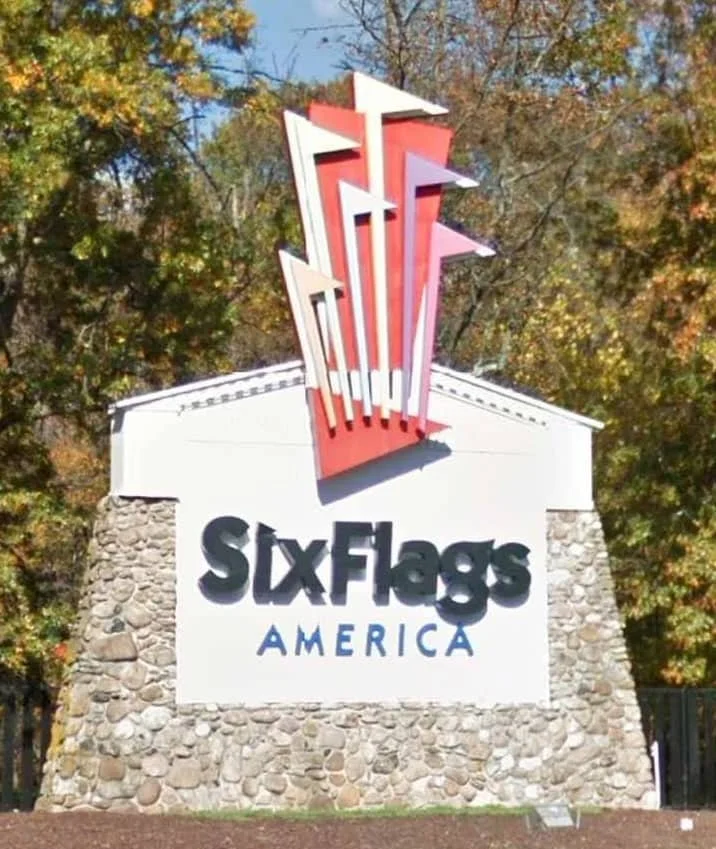
The Storied/Checkered History of Six Flags
With the permanent closing of Six Flags America, and all the other cheerful news from the company, I thought I'd lay out the history of the chain over the years.
The story of Six Flags begins with an industrial developer in the Dallas–Fort Worth area in the late 50s looking for ways to capitalize his ambitious plans. A visit to Disneyland sparked a solution—build a theme park with related facilities and activities, therefore providing relatively quick income to keep things afloat until the industrial part kicked in.
He hired the guy who billed himself as the one who master-planned and built Disneyland, C.V. Wood. That's a story all to itself, but for now we'll just say that C.V. didn't last very long and was replaced by the man who would go on to build a majority of America's regional theme parks—Randall Duell. Six Flags Over Texas opened in 1961, followed by the Georgia park in '67, then Mid-America in '71. All three were custom designed for the region and got progessively better as the designers learned their craft. But along the way Angus and his company got into financial trouble, primarily from his involvement with the 1964-65 World's Fair in NY. He was wiped out and forced to give up the company (but not control, at least yet) to the Pennsylvania Railroad.
Wynne’s deal allowed Six Flags to weather the 70s financial storm that nearly killed other parks such as Carowinds, Great Adventure, and so on. Once its Georgia and Mid-America parks opened, and with its new owner’s resources, the company set course for aggressive expansion. No longer building parks from the ground up, they began a series of acquisitions—slowly in the early years, but a foreshadowing of what would transpire in the 1990s. First was Astroworld in 1975, Great Adventure in 1977, followed by Magic Mountain (California) in 1979. Just a few years later in 1982, Bally Manufacturing purchased the Six Flags assets from what had become the Penn Central Railroad, soon afterward adding the magnificent Marriott’s Great America in Illinois to its portfolio (1984). By 1987, however, the company determined that the parks were too much of a financial drain, largely due to expensive, seasonal operations and the need for significant reinvestment, and not where they wanted to focus their resources. They therefore sold the chain to the Wesray Corporation, which held on for a few years. Time Warner slowly became interweaved into the various ownership splits, finally buying the entire chain outright in 1993. Two years later they turned around and sold a 51% stake in the company to a finance entity, Boston Ventures, retaining partial control over management of the parks. After establishing a management agreement to run Fiesta Texas in 1996, that park became a Six Flags property two years later. These years were generally good for the brand, with extensive reinvestment in the parks, though things gradually began to stagnate as part of the Time Warner empire.
Meanwhile a regional real estate company in Oklahoma unexpectedly found itself trying to help a floundering park make another go of it. Frontier City was destined for the dozers in order to make way for commercial land development. When the deal fell apart, they had little choice but to fix the place up and see what it could do. That it did, enough to make them rethink their purpose in life. Over time TierCo Group would rebrand itself as Premier Parks and embark on a buying spree throughout the 90s and into the new century that would collect such properties as Wild World in MD, Geauga Lake in OH, Darien Lake in NY, and Kentucky Kingdom in Louisville, KY. There were lots more, but the big grab was the entire Six Flags chain in 1998—all eight parks. Add a bunch of international parks as well, and Premier became, well, the premiere chain for regional properties. Rebranding itself again in 2000, this time as Six Flags, the flags began flying over a multitude of parks around the globe.
It was too much. By the mid-2000s the company was clearly in trouble, in over its head in debt and facing demands from shareholders and investors to do something about it. The massive sell-off and draw down commenced, including the infamous decision to demolish Astroworld. The 2008 recession didn’t help matters for anyone in the tourism industry, and so it was a slow climb from the bottom to regain their footing. The general good health of the park business in the second decade of the 2000s helped keep things going in spite of ongoing issues.
The company continued to suffer under inconsistent management, cycling through maybe half a dozen CEOs. The debt burden, largely from overpaying for too many properties they scooped up, was never addressed. Everyone expected Cedar Fair, the white knight who knew how to run a park chain, to restore balance and order to the galaxy. Instead, the combined company is stricken from overwhelming debt, a major talent drain from restructuring, and little goodwill with their customer base. Closing lower-end properties like Six Flags America will not solve their problems, and the very real danger is that in their struggle for survival we could easily lose a number of irreplaceable parks we all have loved for over fifty years.
So what's next for the "new" Six Flags? I've no idea. I just hope it lasts long enough for me to write more history for Imagineering an American Dreamscape, The Sequel.
And right about now we're really mad at the 1970s Howard County planning board in Maryland who squashed Marriott's grand plans for a park in the DC area. Twice.